2.2. Dry convective boundary layer
This is the convective boundary layer scenario described by Sauer and Munoz-Esparza (2020). This case represents the boundary layer conditions at the SWiFT facility near Lubbock, Texas at 4 July 2012 during the period of 18Z-20Z (12:00–14:00 local time), the strongest period of convection on the day.
2.2.1. Input parameters
Number of grid points: \([N_x,N_y,N_z]=[600,594,122]\)
Isotropic grid spacings in the horizontal directions: \([dx,dy]=[20,20]\) m, vertical grid is \(dz=20\) m at the surface and stretched with verticalDeformFactor \(=0.80\)
Domain size: \([12.0 \times 11.9 \times 3.0]\) km
Model time step: \(0.05\) s
Geostrophic wind: \([U_g,V_g]=[9,0]\) m/s
Advection scheme: Hybrid 5th order upwind
Time scheme: 3rd-order Runge Kutta
Latitude: \(33.5^{\circ}\) N
Surface potential temperature: \(309\) K
Potential temperature profile:
Surface heat flux: \(0.35\) Km/s
Surface roughness length: \(z_0=0.05\) m
Rayleigh damping layer: uppermost \(400\) m of the domain
Initial perturbations: \(\pm 0.25\) K
Depth of perturbations: \(400\) m
Top boundary condition: free slip
Lateral boundary conditions: periodic
Time period: \(4\) h
2.2.2. Execute FastEddy
Create a working directory to run the FastEddy tutorials and change to that directory.
Create a Example02_CBL subdirectory and change to that directory.
The FastEddy code will write its output to an output subdirectory. Create an output directory, if one does not already exist.
Run FastEddy using the input parameters file Example02_CBL.in located in the tutorials/examples/ subdirectory of the FastEddy repository.
See Build and Run for instructions on how to build and run FastEddy on NSF NCAR’s High Performance Computing machines.
2.2.3. Visualize the output
Open the Jupyter notebook entitled MAKE_FE_TUTORIAL_PLOTS.ipynb.
Under the “Define parameters” section, modify
path_base, specifying the full path to the Example02_CBL subdirectory, but don’t include the Example02_CBL subdirectory. Be sure to include a trailing slash/).Under the “Define parameters” section, modify
caseto set its value toconvective.Run the Jupyter notebook.
The resulting XY cross section png plots will be placed in a FIGS subdirectory of the Example02_CBL directory.
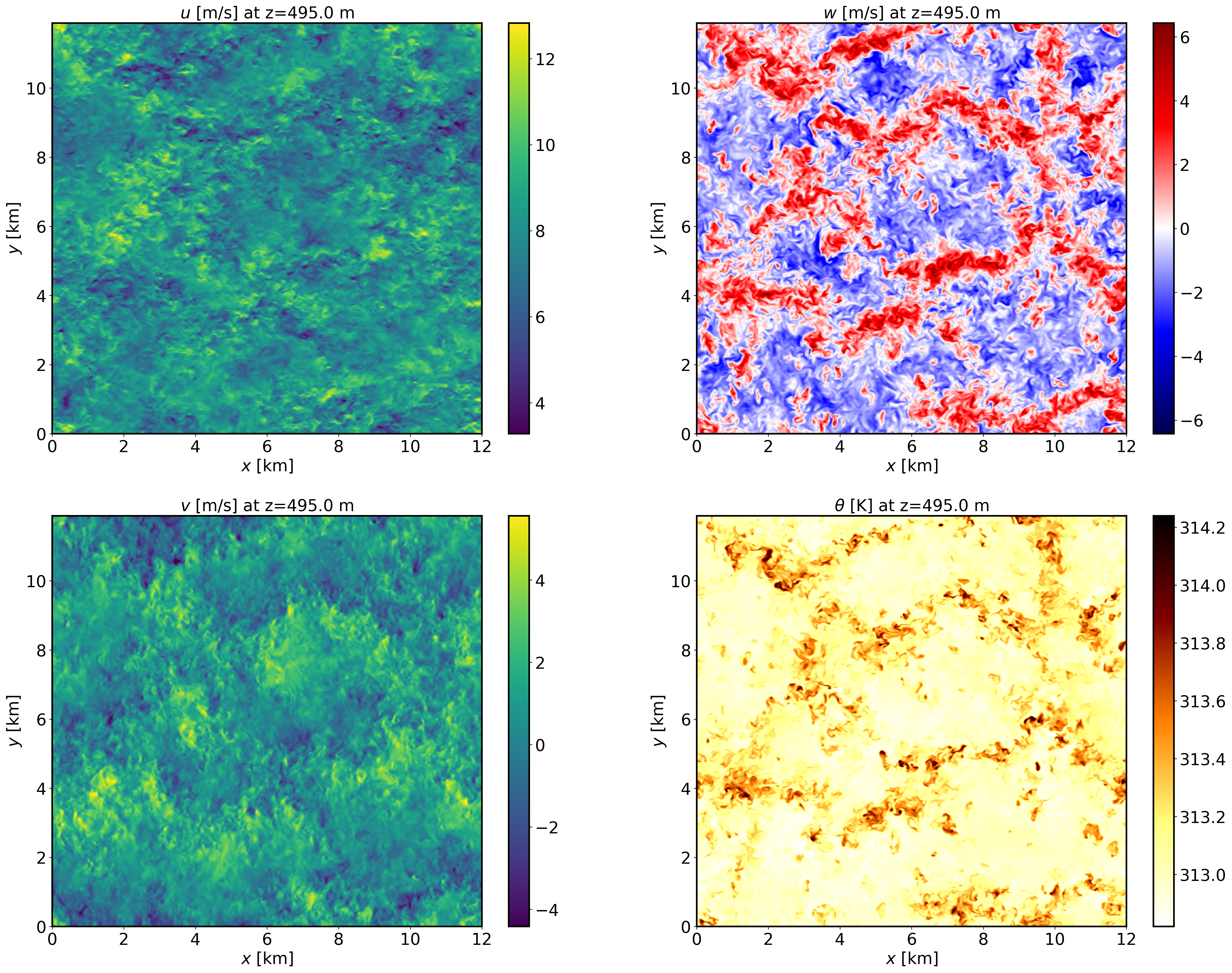
XY-plane views of instantaneous velocity components at \(t=4\) h (FE_CBL.288000):
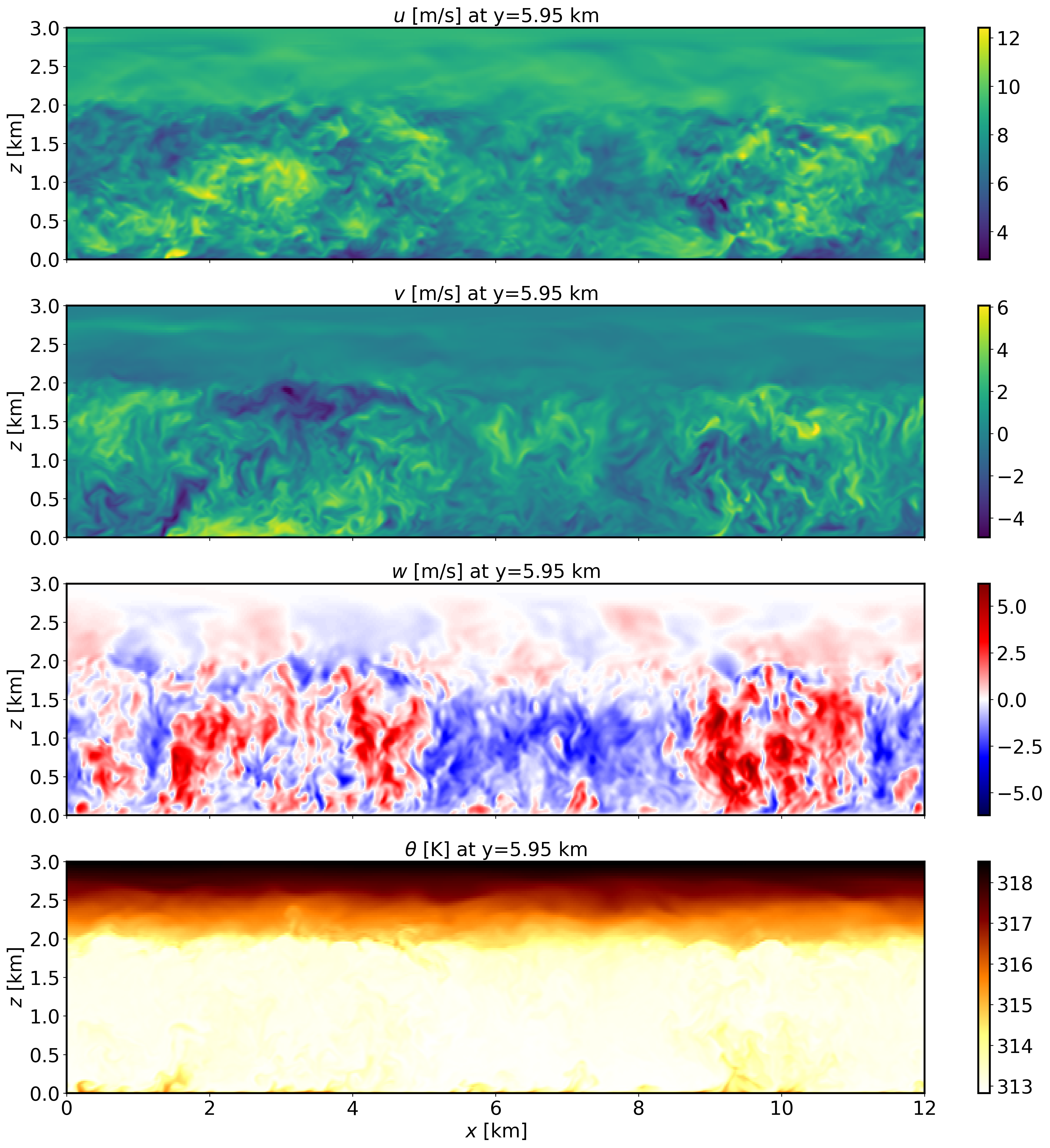
XZ-plane views of instantaneous velocity components at \(t=4\) h (FE_CBL.288000):
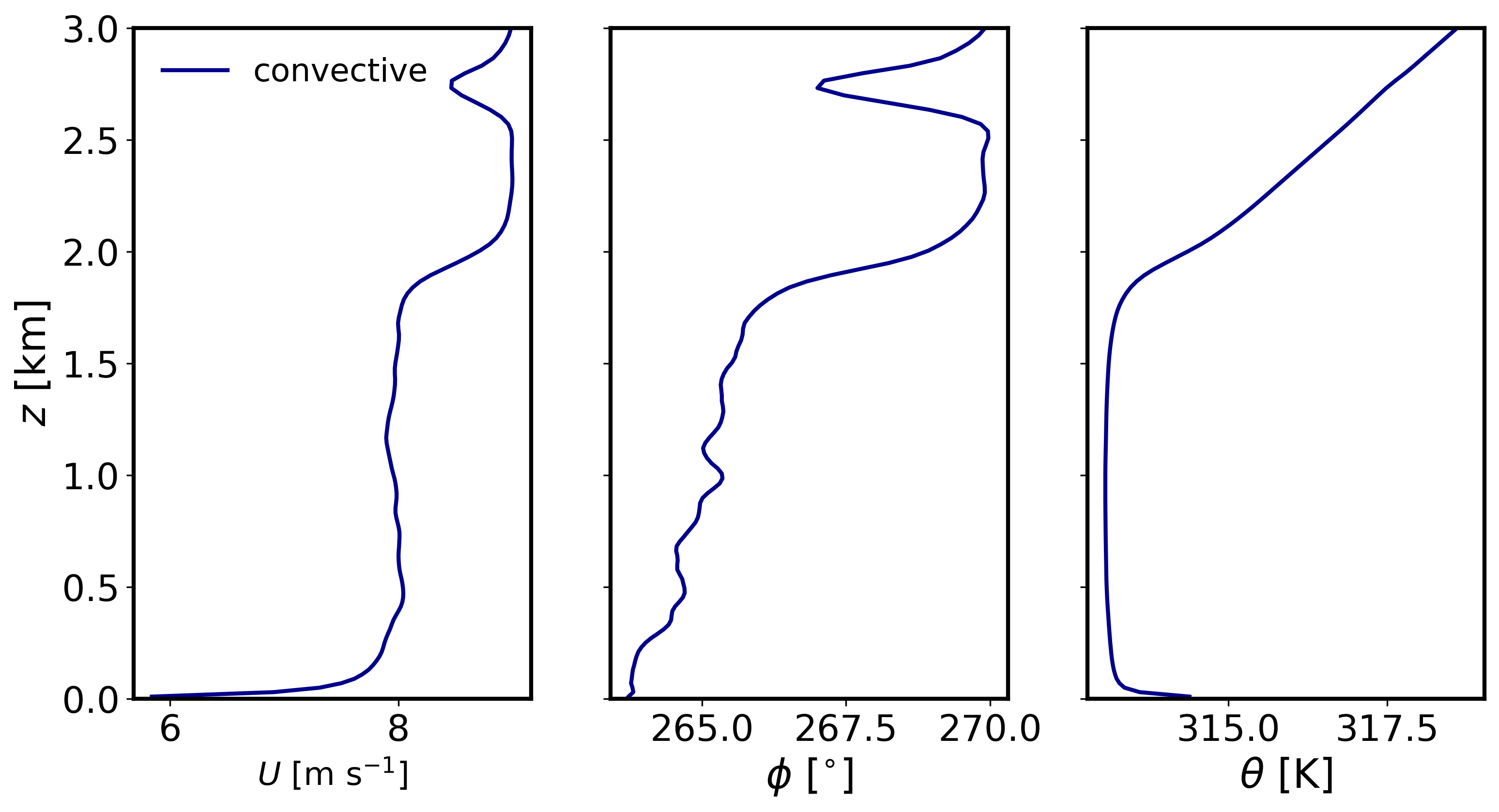
Mean (domain horizontal average) vertical profiles of state variables at \(t=4\) h (FE_CBL.288000):
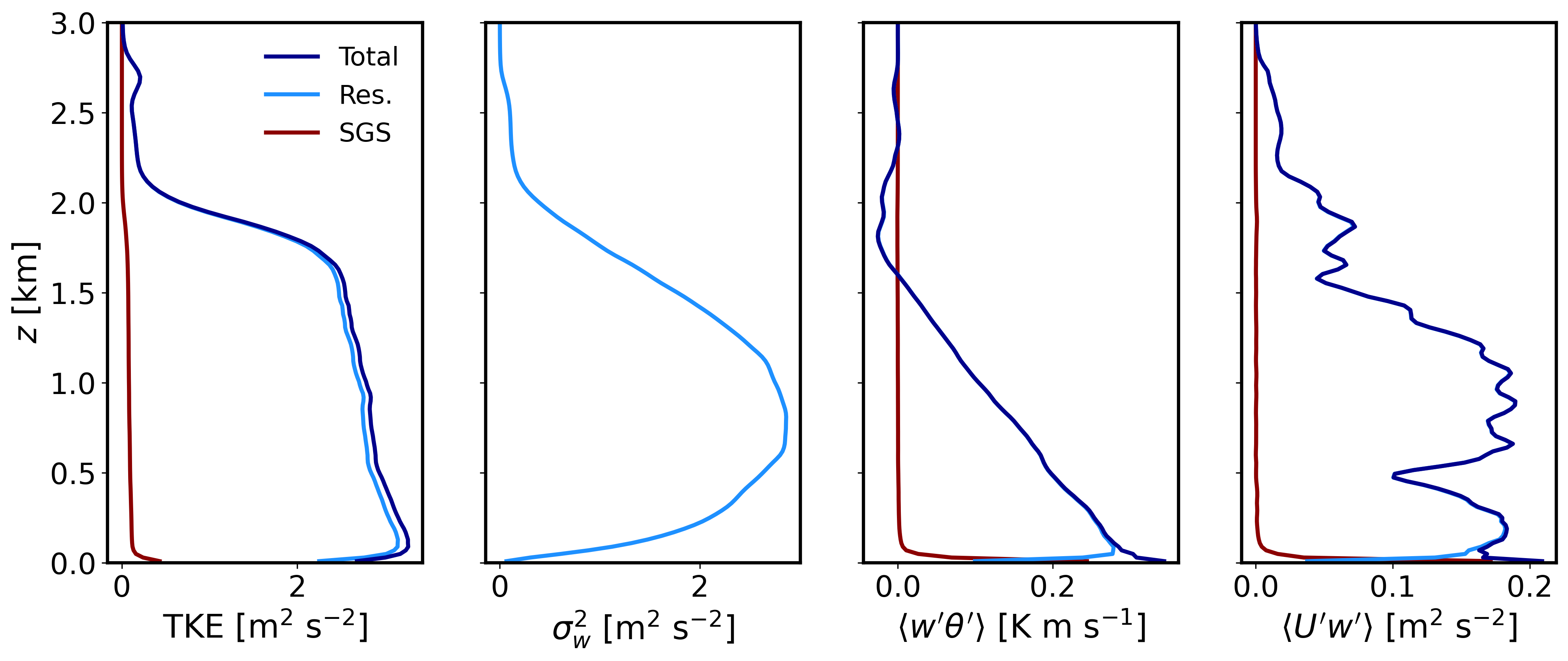
Horizontally-averaged vertical profiles of turbulence quantities \(t=3-4\) h [perturbations are computed at each point relative to the previous 1-hour mean, and then horizontally averaged]:
2.2.4. Analyze the output
Using the XY and XZ cross sections, discuss the characteristics (scale and magnitude) of the resolved turbulence.
What is the boundary layer height in the convective case?
Using the vertical profile plots, explain why the boundary layer is unstable.